FMIPA UGM Students Develop PolPay (Jempol Payment), a Card- and Phone-Free Digital Payment Innovation Using Fingerprint Biometrics
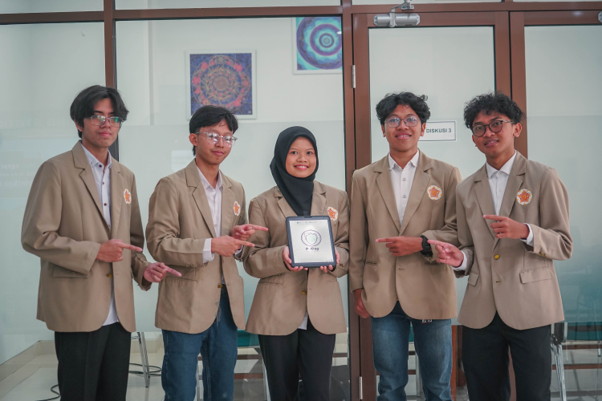
A team of students from the Faculty of Mathematics and Natural Sciences (FMIPA) at Universitas Gadjah Mada (UGM), participating in the Student Creativity Program for Creative Works (PKM-KC), is developing PolPay (Jempol Payment), an innovative digital payment system based on fingerprint biometrics designed to enhance transaction security, convenience, and efficiency. Unlike conventional payment systems, PolPay enables users to make transactions without a card or mobile phone by utilizing biometric authentication.
The PolPay innovation is being developed through a research project titled “Affordable Biometric Payment Device Based on Edge Computing (PolPay) with 256-Bit Advanced Encryption Standard for Privacy-Protected Transactions.” The research is being carried out by five UGM students: Tiara Ramadhani (Actuarial Science, 2025/FMIPA) as the team leader; Al Farabi Obiansyah (Mechanical Engineering, 2025/FT); Marcelino Budi Prakasya (Computer Science, 2025/FMIPA); Muhammad Fakhri Ghonim Setyanda (Electronics and Instrumentation, 2025/FMIPA); and M. Rakhma Aifil Indira (Actuarial Science, 2025/FMIPA), under the supervision of Mokhammad Fajar Pradipta, S.Si., M.Eng.

Unlike conventional payment systems that rely on cards or mobile devices, PolPay integrates a fingerprint sensor with an Electronic Data Capture (EDC) device. Users can authenticate their transactions using their fingerprints, while verification is carried out through the biometric system developed by the team.
As part of its development, PolPay utilizes edge computing to process biometric data. The data is then transmitted to a server in encrypted form using the Advanced Encryption Standard 256-bit (AES-256) and secured through the SSL/TLS protocol. This approach is designed to strengthen user privacy, reduce latency, and minimize the risk of biometric data misuse.
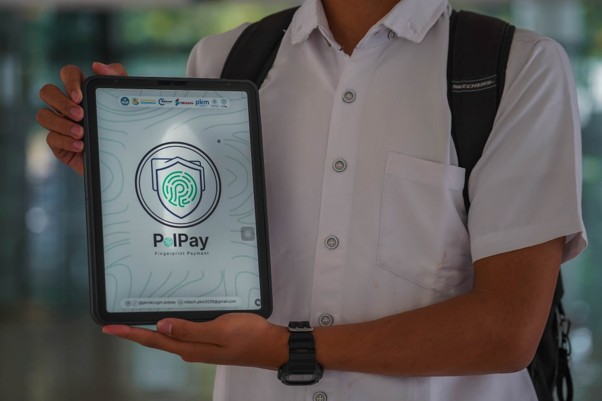
In addition to prioritizing security, PolPay is designed as a more affordable alternative to existing biometric payment technologies, which typically require costly infrastructure. Through this concept, the team aims to develop a payment technology that does not rely on users having a card or mobile phone to complete transactions. The PolPay research is currently at the prototype development stage. This stage forms part of the innovation development process before further testing and development are carried out.
The development of PolPay also supports the direction of Indonesia’s national digital transformation and is aligned with Bank Indonesia’s Indonesia Payment System Blueprint 2030. The innovation is expected to contribute to the development of digital payment technologies that prioritize both security and user privacy.

Overall, the development of PolPay contributes to the achievement of the Sustainable Development Goals (SDGs), particularly SDG 9 (Industry, Innovation and Infrastructure) through the development of innovative and inclusive digital payment technology, as well as SDG 16 (Peace, Justice and Strong Institutions) by strengthening cybersecurity and data protection within the digital transaction ecosystem. The innovation demonstrates how student research can contribute to technology-based solutions that address societal needs and support Indonesia’s digital transformation.


Penulis: Inna Mutifah
Fotografer: Afiandina Sukma