FMIPA UGM Brings in Dr. Rizal Fajar Hariadi to Take Biomolecular Research from Lab to Biotech Startup

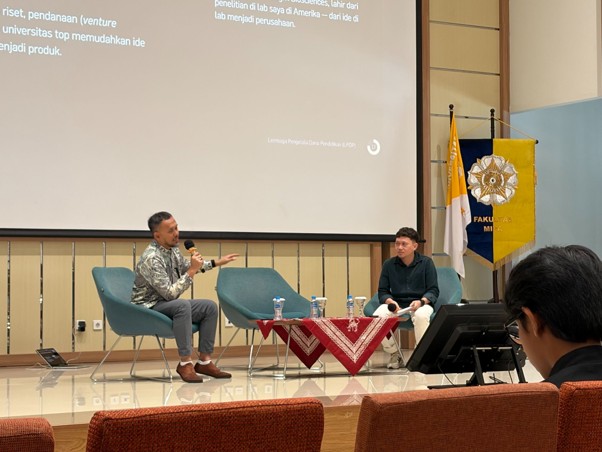
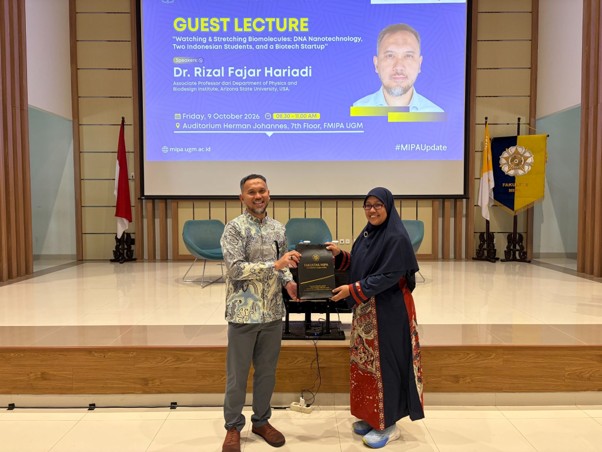
The Faculty of Mathematics and Natural Sciences (FMIPA) Universitas Gadjah Mada (UGM) hosted a guest lecture titled “Watching and Stretching Biomolecules: DNA Nanotechnology, Two Indonesian Students, and a Biotech Startup” on Friday (9/10). Held at the Herman Johannes Auditorium, FMIPA UGM, the lecture brought in Dr. Rizal Fajar Hariadi, an Associate Professor in the Department of Physics at Arizona State University, United States.
During the lecture, Dr. Rizal shared research from his laboratory at Arizona State University, which involves two Indonesian students. The first project, led by Franky Djutanta, looks into the hydrodynamic properties of bacterial flagella. Using high-speed light-sheet microscopy, the research team tracked the rotational and translational diffusion of isolated Escherichia coli flagella.
The researchers then used the data to work out the hydrodynamic coefficients directly by drawing on Einstein’s century-old link between fluctuations and drag. The findings were published in the Proceedings of the National Academy of Sciences (PNAS) in 2023.
The second research project, led by Gde Bimananda Mahardika Wisna, focuses on two DNA nanotechnology platforms, MAESTRO and HALOS. MAESTRO (Multi-directional DNA Origami Force Spectroscopy) is designed as a DNA origami-based force spectroscopy tool that allows researchers to pick up conformational dynamics that conventional single-axis measurements may miss. Meanwhile, HALOS is a cholesterol-anchored DNA hairpin biosensor developed to detect nucleic acids inside living cells without destroying them. Together, the two platforms show how DNA nanotechnology and single-molecule biophysics can be applied to address fundamental scientific questions while also paving the way for practical tools in cell therapy.
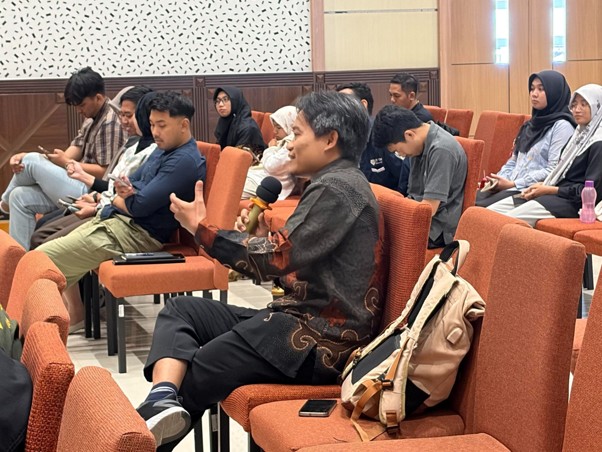
Dr. Rizal also walked participants through how research developed in the laboratory can move beyond academia and into the industry through a biotech startup. The journey highlights how fundamental research can be taken forward into technologies with potential applications outside the academic setting.
Through the guest lecture, students and participants gained insights into biomolecular research, DNA nanotechnology, and opportunities to turn scientific research into biomedical and biotechnology applications. The research led by Indonesian students in an international academic environment also highlighted their contributions to the development of science and technology on a global scale.
The event also supported efforts to strengthen education and research in science and technology by bringing together students, academics, and researchers to share knowledge and research experiences. The initiative aligns with Sustainable Development Goal (SDG) 4: Quality Education and SDG 9: Industry, Innovation and Infrastructure, particularly through strengthening academic capacity and turning scientific research into innovation.

Writer: Inna Mutifah
Photographer: Akmal