Data Art 2026 Turns Earthquake Data and Fire Traces into Art
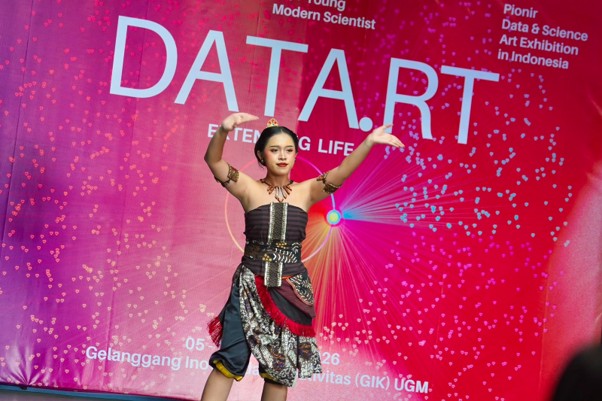
Yogyakarta, October 10, 2026 — Forty artworks by 37 scientists from various disciplines invite the public to explore issues surrounding life through art at Data Art 2026: Extending Life. Held at Gelanggang Inovasi dan Kreativitas (GIK) of Universitas Gadjah Mada (UGM), the exhibition turns data on earthquakes, forest fires, and human health into artworks that bridge scientific research and everyday experiences.
Denyut Sumatera 1998—2024 visualizes 5,044 earthquakes with magnitudes of 4.5 or higher in Sumatra as the pulse of the Earth. As If Ash Remains arranges matchsticks into a map of Indonesia to trace the impact of forest fires, while Hazard in Beauty brings to light the threat of oil pollution hidden behind the colorful appearance of coastal areas. Together, the works encourage visitors to take in the data while reflecting on its impact on human life.
Health-related issues also come through in Glucowrap, a sensor-based device developed to support foot-condition monitoring for people with diabetes. Meanwhile, Emergence of Being brings art and mathematics together through an abstract face generated from mathematical functions.
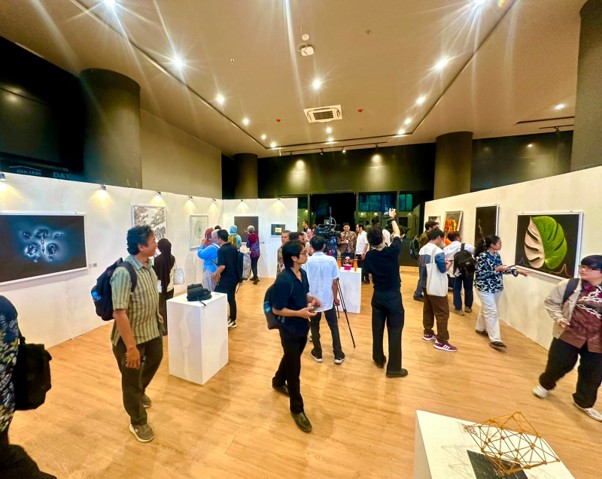
The exhibition opened on October 5, 2026, with Dr. Michael Hoch, a physicist and artist involved in the CMS experiment at CERN, Switzerland, as the keynote speaker. Hoch founded art at CMS, a program that brings together particle physics, art, and education to make scientific research more accessible to the public through exhibitions and workshops. Hoch highlighted the idea that “Art gives people room to imagine science in a simpler and more emotional way.”
Data Art 2026 is organized by the Faculty of Mathematics and Natural Sciences (FMIPA) UGM, with the UGM FMIPA Alumni Association (KAMIPAGAMA) serving as the event partner. The exhibition marks the second edition following Indonesia, Life Behind Data in 2025.
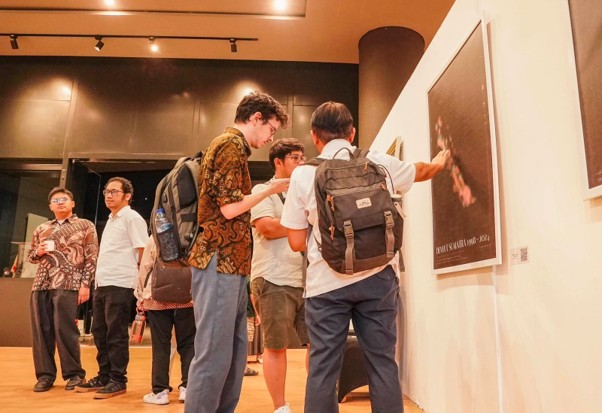
Under the theme Merawat Denyut, Menjaga Ingatan (Caring for the Pulse, Preserving Memories), Dean of FMIPA UGM Prof. Dr.-Ing. Mhd. Reza M. I. Pulungan, S.Si., M.Sc., said in his remarks that Data Art 2026 brings university research into public spaces and presents data as a means of caring for life and preserving collective memory. Data, he added, records human thoughts and experiences that can continue to be interpreted across time.
KAMIPAGAMA Chair Daniel Oscar Baskoro also noted that the range of creative approaches and artworks shows how scientific research and data can be translated into forms of art that the public can see and understand.
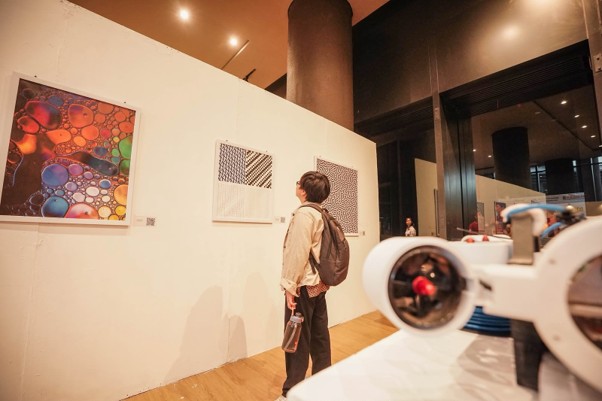
Running from October 5 to 11, 2026, the exhibition uses art as a way to expand data and science literacy. By bringing research findings into public spaces, Data Art 2026 opens up conversations about the role of knowledge in understanding disaster risks, protecting the environment, and safeguarding health for the sustainability of life.
The effort to expand science literacy through Data Art 2026 aligns with the Sustainable Development Goals (SDGs), particularly SDG 3 on good health and well-being, SDG 4 on quality education, SDG 11 on sustainable cities and communities, and SDG 13 on climate action. By turning data on earthquakes, forest fires, pollution, and health into artistic material, the exhibition creates opportunities for the public to better understand these issues and see how they are connected to the sustainability of life.
Contact: mipa@ugm.ac.id


Writer: Kamipagama
Editor: Inna Mutifah
Photographer: Afiandina Sukma