FMIPA UGM Explores Strategic Pathways for Indonesia’s Semiconductor Industry
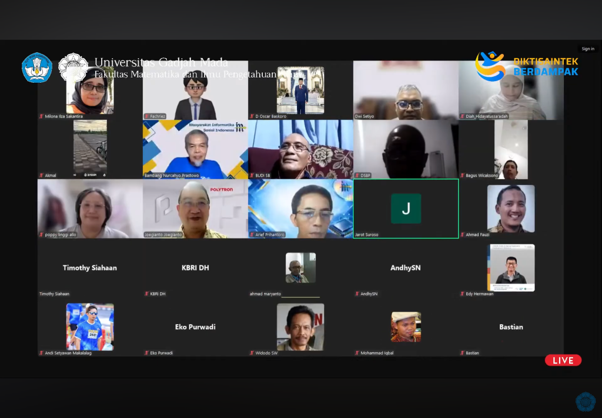
The Faculty of Mathematics and Natural Sciences (FMIPA) Universitas Gadjah Mada (UGM) held a webinar on Friday, September 26, to discuss Indonesia’s prospects for developing its semiconductor industry and strengthening its role in the global supply chain.

Moderated by Daniel Oscar Baskoro, S.Kom., M.Sc., the discussion looked at how Indonesia’s semiconductor industry could take shape by 2029. The speakers pointed to the need to build up the industrial ecosystem, develop skilled talent, and prepare more Indonesian chip designers.
The webinar was part of FMIPA UGM’s 71st anniversary series. It brought together representatives from the diplomatic, academic, industrial and research sectors to look at Indonesia’s position and potential role in the global semiconductor ecosystem.
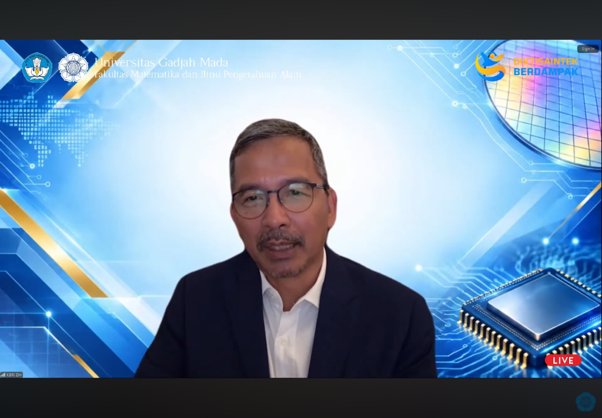
Indonesian Ambassador to the Kingdom of the Netherlands, Laurentius Amrih Jinangkung, said Indonesia should identify areas that could serve as entry points into the semiconductor industry. He said the country did not need to take on the entire supply chain at once because of its complexity.
“The semiconductor supply chain is highly complex, so Indonesia needs to determine which areas can serve as entry points,” Laurentius said.
He said Indonesia would need to build up its science and technology talent, research capacity, and investment. The country would also need to connect its capabilities with global supply chains.
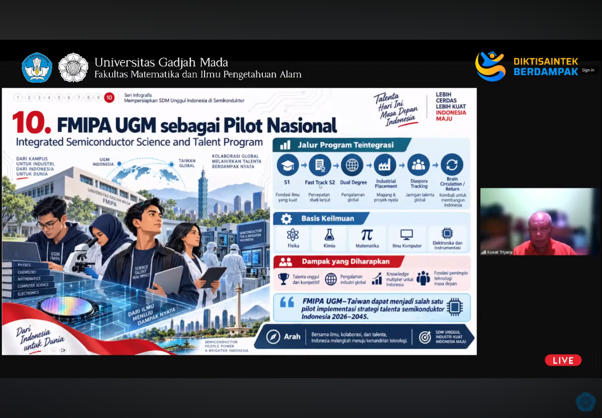
FMIPA UGM Dean Prof. Dr. Eng. Kuwat Triyana said developing human resources would be an important part of building up Indonesia’s capacity in the semiconductor sector. He said the faculty had been mapping out industry needs and working to expand interdisciplinary collaboration and pathways that connect education with industry experience.
These pathways include double-degree programs, fast-track programs and industrial placements. “FMIPA UGM is responding to these needs through semiconductor talent development, industry-needs mapping, interdisciplinary collaboration, and education and industry-experience pathways,” Prof. Kuwat said.
FMIPA UGM’s eight undergraduate programs include physics, chemistry, mathematics, computer science, and electronics and instrumentation. These programs provide different scientific backgrounds that can help build up talent for the semiconductor sector.
From the industry side, Joegianto, a representative of Polytron, said Indonesia did not have to move into large-scale chip manufacturing immediately. Setting up facilities comparable to those operated by major global semiconductor manufacturers would require substantial capital and infrastructure, he said.
Instead, Indonesia could focus on parts of the industry that build on its existing capabilities.
“Indonesia needs to determine a position within the semiconductor industry that matches its national strengths and does not have to develop every stage of the industry at once,” Joegianto said.
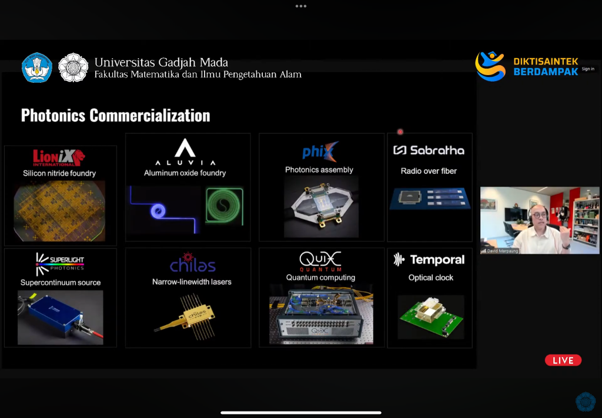
Prof. David Marpaung of the University of Twente in the Netherlands also said domestic fabrication facilities did not have to be Indonesia’s first step. Given the high cost of building such facilities, he said Indonesia could start by focusing on chip design and intellectual property (IP). Fabrication could then be carried out through partnerships with existing facilities.
Timoti Siahaan, Ph.D., a Research and Mass Transfer Architect at ASML Netherlands, said semiconductors should be viewed as a connected industrial ecosystem rather than a single manufacturing process.
“The semiconductor industry is a broad ecosystem with many interdependent parties,” Timoti said. He added that human resources and infrastructure were two key foundations of the ecosystem.
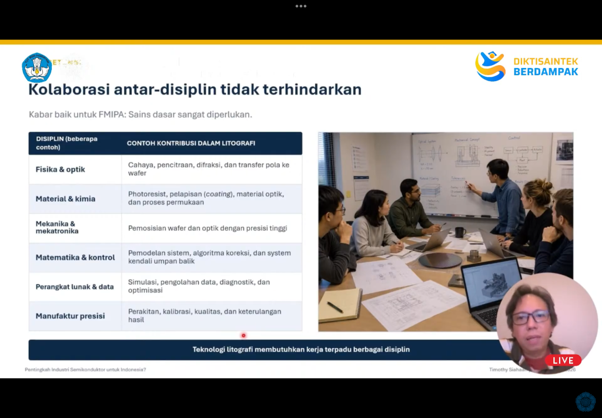
The discussion also looked at research, chip design, semiconductor materials and infrastructure as areas that could help Indonesia move into the global semiconductor supply chain. Large-scale fabrication facilities could come at a later stage as domestic capabilities and the wider ecosystem develop.
The webinar was organized by FMIPA UGM in collaboration with Kamipagama and the Indonesian Information Society (Masyarakat Informatika Sosial Indonesia/MISI).
The development of semiconductor talent and science and technology education supports Sustainable Development Goal (SDG) 4 on Quality Education. Efforts to build up research, technology and infrastructure also contribute to SDG 9 on Industry, Innovation and Infrastructure. Cooperation between academia, industry, government and research institutions supports SDG 17 on Partnerships for the Goals.

Writer: Inna Mutifah