Digital Transformation of the FMIPA UGM Website Ecosystem 2026: Building an Integrated and Sustainable Academic Information Environment
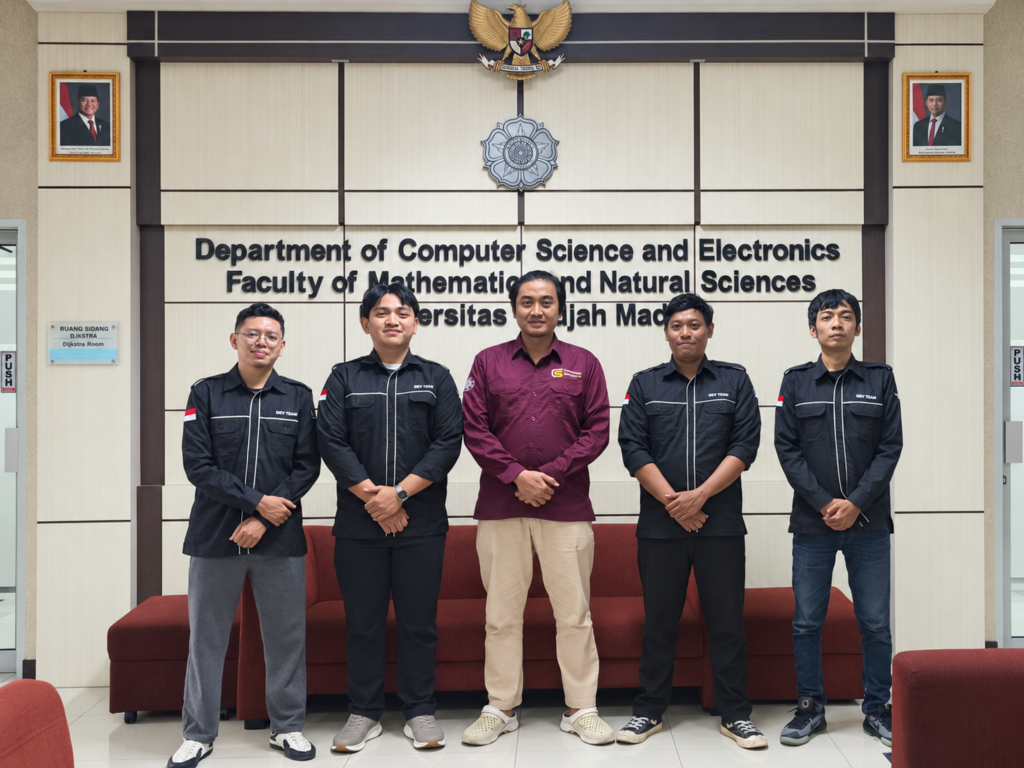
A university website is no longer merely a digital noticeboard. It functions as an institutional gateway through which prospective students, current students, academic staff, alumni, industry partners, international collaborators, and the wider public encounter the university’s academic identity, services, research activities, and institutional achievements. In this context, the Faculty of Mathematics and Natural Sciences, Universitas Gadjah Mada (FMIPA UGM), initiated the FMIPA UGM Website Digital Transformation 2026 as a systematic effort to improve not only the visual appearance of its websites, but also the way information is structured, accessed, maintained, and sustained over time.
The transformation is designed as an ecosystem-level initiative. Rather than treating the faculty website and each department website as isolated digital products, the project seeks to establish a coherent information environment in which the faculty portal, departmental websites, programme information, academic documents, research content, and institutional services can be connected through a more consistent architecture.
From User Needs to Information Architecture
The transformation began with a structured assessment of website needs at both faculty and department levels. Inputs from institutional leaders, department representatives, and website administrators revealed a recurring set of priorities: the new website ecosystem should be lightweight, responsive, easy to navigate, less visually crowded, and more manageable for administrators. At the same time, the websites were expected to communicate FMIPA UGM’s academic strengths more effectively by highlighting degree programmes, research and innovation, facilities and laboratories, accreditation, achievements, alumni, collaboration opportunities, and institutional services.
These findings shaped the information architecture of the new ecosystem. The work therefore extended beyond interface redesign. Existing pages, documents, menus, and content relationships were reviewed to determine which information should be migrated, consolidated, updated, archived, or redirected. In several cases, a single new page or component is designed to replace a fragmented set of legacy pages while preserving access to the underlying information through clearly structured sections, links, document repositories, and redirects.
This approach reduces unnecessary duplication while retaining the institutional value of historical content. It also establishes clearer ownership of information: the faculty website functions as a central portal, while department websites provide more detailed academic and operational information relevant to their respective disciplines.
Benevolent White as the Faculty-Level Design Foundation
At the faculty level, the project introduced Benevolent White as the principal website template. The concept is intended to support mipa.ugm.ac.id as the primary digital gateway of FMIPA UGM. Benevolent White adopts a clean, content-oriented visual language in which the institutional blue and yellow identity remains recognisable but is applied with greater restraint, allowing academic information and user pathways to take priority.
The design philosophy does not interpret “white” merely as a visual colour choice. Instead, it reflects an effort to create sufficient visual space, reduce interface density, and establish a clearer hierarchy of information. Reusable components, consistent page structures, and controlled plugin dependency are also incorporated to improve maintainability and long-term technical sustainability.
The faculty website is consequently positioned as the main portal for institutional information, academic services, faculty-level news and agendas, links to departments, research and innovation, partnerships, and integrated information discovery across the FMIPA UGM digital environment.
Resolute Blue and a Unified Department Website Framework
The digital transformation also includes the websites of the four departments within FMIPA UGM: Mathematics, Chemistry, Physics, and Computer Science and Electronics. Rather than developing four unrelated website structures, the project uses Resolute Blue as a unified department template that can be adapted to the specific academic identity and information requirements of each department.
This model allows the departments to maintain distinct content, accent colours, visual materials, programme structures, research profiles, facilities, laboratories, accreditation information, achievements, alumni content, and partnership information while preserving a consistent user experience across the faculty ecosystem. The approach is intended to support both institutional unity and disciplinary identity.
In this architecture, department websites operate as detailed academic information centres, whereas the faculty website functions as the principal institutional gateway. This separation reduces unnecessary duplication and provides users with a more predictable path from general faculty-level information to discipline-specific content.
Preserving Institutional Memory through Content Migration and Redirects
A central challenge in institutional website transformation is the preservation of information accumulated over many years. News archives, accreditation documents, academic guidelines, faculty profiles, historical activities, and externally referenced URLs often continue to hold administrative, academic, and reputational value. For this reason, the project does not adopt a “replace everything” strategy.
Legacy content is instead reviewed through an audit process to determine whether it should be migrated, consolidated, revised, archived, or retained through a relevant source link. Where URL structures change, legacy addresses are mapped to the most appropriate new destinations so that users following older references can still reach the intended information. This redirect strategy is particularly important for accreditation materials, institutional documents, frequently referenced academic pages, and content that may already be indexed by search engines.
Documentation as Part of Digital Content Development
The quality of an institutional website depends not only on programming and interface design, but also on the quality and authenticity of the content presented to the public. The transformation therefore includes visual documentation of academic spaces, facilities, activities, and institutional environments that can be incorporated into the new websites.

Using original documentation allows the website to represent the academic environment more accurately than would be possible through generic or stock imagery. It also supports the project’s broader objective of presenting FMIPA UGM as an active academic community rather than as a collection of administrative pages.
Iterative Development, Evaluation, and User Acceptance
The website ecosystem is developed iteratively. Prototypes and implementation results are not treated as final outputs at the first stage; instead, they are reviewed and refined in response to feedback from users and institutional stakeholders. This process enables navigation, page composition, content presentation, technical features, and operational requirements to be adjusted before production deployment.
User Acceptance Testing (UAT) and performance evaluation form part of this validation process. The objective is not simply to verify that features function technically, but also to confirm that the websites remain usable, responsive, maintainable, and aligned with the information needs identified during requirements analysis.
Performance as a Design Requirement
Performance optimisation is treated as a design and engineering requirement rather than as a final cosmetic adjustment. Asset loading, image use, responsive behaviour, component complexity, and plugin dependency are considered throughout development so that the website remains efficient across desktop and mobile environments.

The audit snapshot shown above records a performance score of 98, an accessibility score of 91, and scores of 100 for both Best Practices and SEO at the time of measurement. These results should be interpreted as a point-in-time technical evaluation rather than as permanent guarantees, because performance metrics can change as content, scripts, network conditions, server configuration, and third-party resources evolve. Nevertheless, the result indicates that performance and technical quality have been treated as measurable requirements within the development process.
Collaboration in the FMIPA UGM Digital Transformation
The FMIPA UGM Website Digital Transformation 2026 is a collaborative process involving institutional stakeholders and teams responsible for requirements analysis, UI/UX design, technical development, translation, documentation, testing, and validation. This multidisciplinary structure is necessary because sustainable institutional websites depend on the alignment of content governance, design quality, technical implementation, and long-term administrative practice.
Website development and technical implementation are carried out in collaboration with PT Sheen Studio Indonesia as the development partner for the FMIPA UGM Website Digital Transformation 2026.
Building a Sustainable Digital Foundation
Digital transformation does not conclude when a website is launched. Its long-term value depends on how consistently content is updated, how effectively administrators can manage the system, how redirects and broken links are monitored, how performance and security are reviewed, and how institutional responsibilities are maintained after handover.
For this reason, the project also emphasises technical documentation, reusable components, content management procedures, administrator training, and post-launch evaluation. These measures are intended to ensure that the new website ecosystem remains maintainable and adaptable as academic information, organisational needs, and digital practices continue to evolve.
Through the FMIPA UGM Website Digital
Transformation 2026, the faculty is establishing not only a more contemporary visual presence, but also a more coherent and sustainable academic information environment—one designed to support institutional communication, academic visibility, accreditation needs, collaboration, and user access across the faculty and its departments.